
Small Business Insurance on Long Island and in New York City: A Practical Guide by Industry
Adam Erickson
Jul 24 2026 16:28
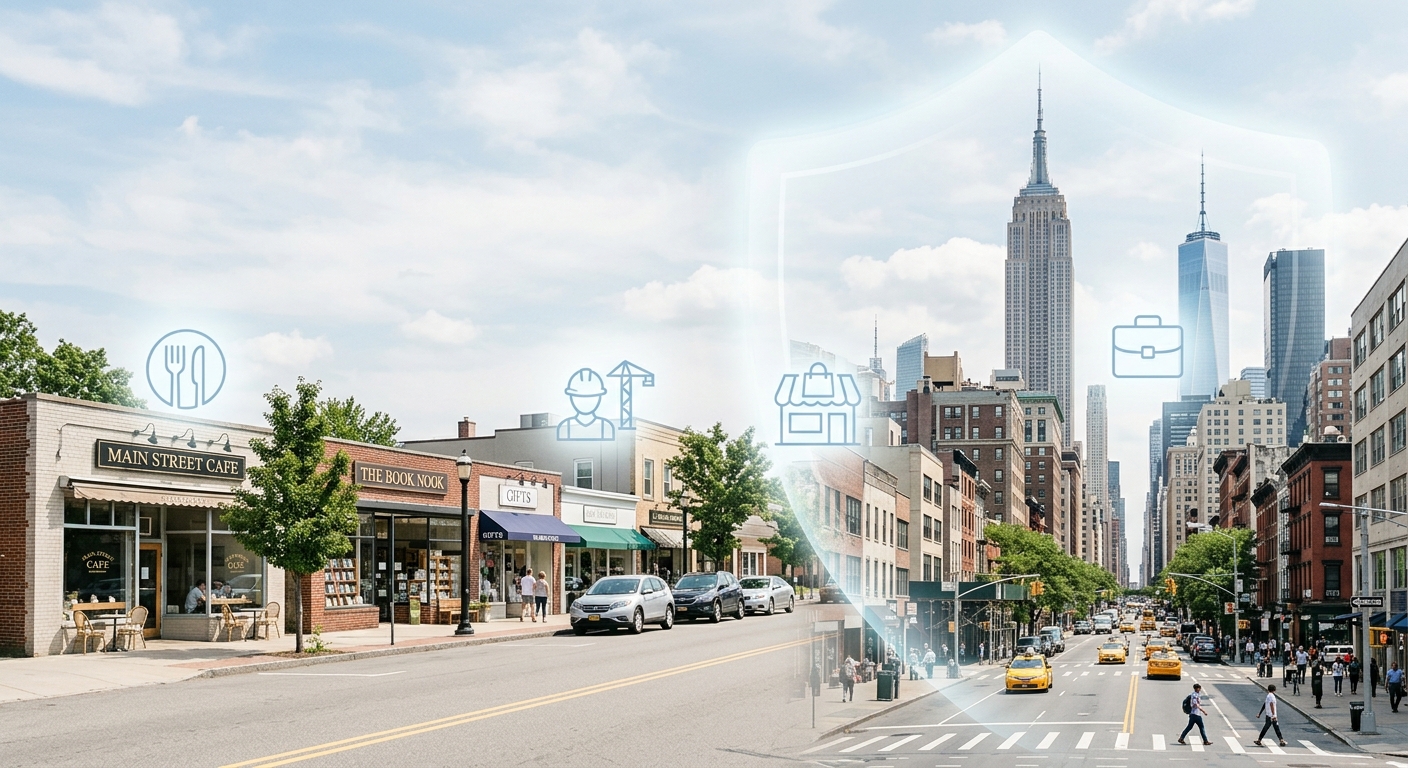
New York is one of the most demanding business insurance environments in the country — not because insurance is uniquely complicated, but because New York's legal and regulatory requirements are more expansive than most states, the consequences of underinsurance are more severe in a high-litigation market, and the cost of a single gap in coverage can be catastrophic for a small business that doesn't have the reserves to absorb an uninsured loss.
This guide is written for small business owners on Long Island and in New York City. It covers what coverage most businesses need, what the legal requirements are in New York, and what specific risks apply to the industries we work with most — restaurants, apartment building owners, auto service shops, professional offices, and retailers.
What Most New York Small Businesses Need — The Foundation
Before getting into industry-specific coverage, there's a foundation that applies to virtually every business operating in New York.
Workers' Compensation Insurance
New York State requires workers' compensation coverage for every employer with one or more employees. This includes full-time workers, part-time workers, seasonal workers, and in many cases family members who receive compensation. There are no exceptions based on business size, industry, or time in operation.
The penalties for non-compliance are severe: $2,000 in civil fines for every 10-day period without coverage, potential criminal liability (misdemeanor for first offense, felony for repeat), and stop-work orders that can shut a business down immediately. The Workers' Compensation Board is active in enforcement and investigates non-compliance aggressively.
Workers' comp premiums are assigned based on industry classification codes. Getting the right classification matters — businesses misclassified at a higher-risk code overpay, and the discrepancy is often not discovered until a payroll audit at renewal. Working with an experienced agent who knows New York's classification system can reduce premium costs and avoid audit surprises.
Business Owner's Policy (BOP)
A Business Owner's Policy is the standard commercial coverage package for most small businesses. It combines three coverages in a single policy: general liability, commercial property, and business interruption. Buying these separately typically costs more than a BOP, and most small businesses qualify — generally those under $5M in annual revenue operating in an eligible industry.
General liability covers third-party bodily injury and property damage claims — the customer who slips in your parking lot, the property you accidentally damage while performing a service, the personal injury claim from an advertising dispute. Most commercial leases in New York City and Long Island require GL as a condition of tenancy, with minimum limits of $1M per occurrence / $2M aggregate and the landlord named as an additional insured.
Commercial property covers your equipment, inventory, and business personal property. It does not cover a commercial tenant's belongings under the building owner's policy — every tenant needs their own.
Business interruption coverage replaces lost income if a covered event forces you to close temporarily. Post-2020, most small business owners are acutely aware of what a temporary closure costs. Business interruption coverage is what bridges that gap — paying rent, payroll, and operating expenses while repairs are made.
Employment Practices Liability Insurance (EPLI)
New York City's Human Rights Law is the most expansive anti-discrimination employment law in the country. It applies to employers with four or more employees and covers 30+ protected categories — far more than federal law. New York State's Human Rights Law applies to all employers regardless of size, with standards for harassment claims that are broader than federal law (a single incident can constitute actionable harassment).
EPLI covers your business against claims of wrongful termination, harassment, discrimination, and retaliation. In New York, the cost to defend a single employment claim — even one that is ultimately dismissed — frequently exceeds $75,000. A BOP endorsement for EPLI typically costs $800 to $2,500 per year. The math makes a compelling case.
Restaurant Insurance on Long Island and in New York City
Restaurants face a concentration of risks that make generic commercial insurance inadequate. A standard BOP without restaurant-specific endorsements will leave significant gaps.
Liquor Liability
New York's Dram Shop Law (Alcoholic Beverage Control Law Section 11-101) makes licensed alcohol vendors civilly liable for injuries caused by patrons who were served at their establishment — including after those patrons leave. A single Dram Shop lawsuit in New York can exceed $500,000. Standard GL policies typically exclude liquor liability. A BOP endorsement or standalone liquor liability policy is required.
Food Spoilage and Equipment Breakdown
A commercial refrigeration failure in a Nassau County restaurant kitchen can destroy thousands of dollars in perishable inventory overnight. Standard commercial property policies typically exclude food spoilage as a cause of loss, or cover it only under a specific endorsement. Equipment breakdown coverage separately covers the mechanical failure of refrigeration units, fryers, ovens, and other commercial kitchen equipment — a coverage that the standard property form does not include.
Workers' Compensation for Restaurant Employees
Restaurant workers' comp is complex in New York because of how tipped employees are classified. Tip income is part of the payroll base for workers' comp purposes, and misclassification of tipped employees — particularly servers — is one of the most common audit findings in the food service industry. Getting the classification and payroll reporting right from the start avoids mid-term adjustments and year-end audit bills.
EPLI for Restaurants
Restaurants generate employment practices claims at a higher rate than most industries. Tip pool disputes, kitchen harassment, wrongful termination of front-of-house staff, and wage theft allegations (tip credit, overtime misclassification) are all recurring issues for restaurant owners in New York. EPLI is not optional for most New York restaurant operators — it is a practical necessity.
Long Island restaurant concentrations worth noting for coverage purposes: Huntington Village, Great Neck, Garden City, Bay Shore, and Babylon all have significant restaurant corridors with elevated foot traffic liability exposure. Brooklyn's Flatbush, Bay Ridge, and Crown Heights corridors and Queens' Flushing and Jackson Heights restaurant districts operate in the full scope of NYC Human Rights Law.
Apartment Building and Landlord Insurance on Long Island and in NYC
Building owners face a distinct set of risks from their tenants, their building systems, and the regulatory environment — particularly in New York City, where landlord liability is extensive and the cost of a single tenant injury claim can be severe.
Building Owner Coverage vs. Standard Landlord Policy
A basic landlord dwelling fire policy — the type written for single-family rentals — is inadequate for a multi-unit apartment building. A commercial building owner's policy includes general liability for tenant injuries in common areas, loss of rental income, equipment breakdown for boilers, HVAC, and elevators, and in some structures coverage for the building super's employment-related liability.
Loss of Rental Income
New York City's HPD, DOB, and other regulatory agencies can order units vacated following structural, habitability, or code violations. When that happens, the building owner stops receiving rent while remaining obligated on the mortgage. Loss of rental income coverage pays the rent owed during covered vacancies — protecting cash flow while the underlying issue is resolved.
Workers' Compensation for Building Staff
Building owners who employ a superintendent, porter, or part-time maintenance worker are required to carry workers' comp in New York. This is one of the most consistently overlooked requirements among smaller building owners in Nassau and Suffolk Counties, and the penalties for non-compliance apply here exactly as they do for any other employer.
Liability for Tenant Injuries
Landlord liability in New York for tenant injuries in common areas — hallways, stairwells, lobbies, parking lots — is significant. NYC's Housing Maintenance Code creates additional exposure for violations that go unaddressed. A properly structured building owner's policy provides coverage for these claims including legal defense costs.
Long Island building owners with South Shore properties face additional flood exposure. Loss of rental income during a flood event, and the question of whether structural damage from flooding is covered, are worth reviewing with your agent before storm season.
Auto Service Shop Insurance on Long Island and in NYC
Car washes, mechanics, body shops, and tire shops require a coverage structure that is fundamentally different from a standard commercial policy — and the gap between what they have and what they need is one of the most common and costly coverage mistakes in this industry.
Garage Liability vs. General Liability
Standard GL does not cover vehicles in the shop's care, custody, or control. This is not a gray area — it is an explicit exclusion in the standard commercial GL policy. A garage liability policy is specifically designed for auto service businesses and covers both the premises and operations liability of a standard GL plus liability for owned vehicles.
Garagekeepers Insurance
Garagekeepers coverage insures customer vehicles while they are on your property — in the shop, on the lot, or being test-driven by a technician. Without it, if a customer's car is stolen from your lot, damaged in a fire in your shop, or hit while parked, that loss is yours to bear. This is a separate coverage from garage liability and must be specifically purchased.
NYC DCWP Registration Requirements
All auto repair shops operating in New York City must register with the NYC Department of Consumer and Worker Protection. Registration requires proof of insurance and a surety bond and must be renewed annually. Operating without registration is a violation that carries fines up to $500 per violation.
Workers' Compensation for Auto Service Workers
Auto service workers carry elevated class codes for workers' comp in New York due to lift hazards, chemical exposure, and falling equipment. Accurate classification is important here — overpaying on an incorrect code is common, and the difference can be material for a shop with multiple technicians.
Professional Office Insurance on Long Island and in NYC
Dentists, architects, accountants, attorneys, and consultants need a coverage structure that addresses both the physical office and the professional services provided from it — and these are two distinct coverages that work together but cannot substitute for each other.
Professional Liability (Errors & Omissions)
A BOP covers third-party bodily injury and property damage. It does not cover claims arising from professional errors, omissions, or negligent advice. A dentist whose patient claims a botched procedure, an architect whose plans contain a structural error, or an accountant whose advice results in a client's financial loss — all of these claims are professional liability claims, not GL claims. Professional liability (E&O) coverage must be purchased separately.
HIPAA and Data Breach for Healthcare Offices
Dental and medical practices on Long Island and in NYC face HIPAA compliance obligations and meaningful data breach exposure. Patient records are a significant cyber liability target. Cyber liability coverage, which can be added to a BOP as an endorsement or purchased as a standalone policy, covers breach notification costs, credit monitoring for affected patients, regulatory defense, and in some cases ransom payments in ransomware events.
EPLI for Professional Offices
Professional offices with administrative staff — front desk, billing, medical assistants — face the same employment practices exposure as any other employer in New York. Nassau County has a high concentration of dental, medical, legal, and financial practices, many of them operating without formal HR policies or documented employment procedures. EPLI is appropriate for virtually any professional practice with non-owner employees.
Retail Business Insurance on Long Island and in NYC
Retailers face customer injury liability, employee crime exposure, business interruption risk from temporary closures, and — particularly in NYC — the full scope of the NYC Human Rights Law for part-time and seasonal staff.
Commercial Crime Coverage
Standard property policies do not automatically include coverage for employee theft, shoplifting losses, or burglary beyond the basic property deductible. A commercial crime endorsement specifically covers these losses — important for any retail business with cash on hand, high-value inventory, or significant employee access to financial systems.
Compliance with Lease Insurance Requirements
NYC and Long Island commercial retail leases consistently require GL with limits of at least $1M per occurrence / $2M aggregate, the landlord as additional insured, and an annual COI delivered before occupancy. Many small retailers don't realize their lease requires them to carry workers' comp as well. An agent who reviews the lease before binding coverage ensures the policy meets every requirement the landlord has imposed.
Frequently Asked Questions About Small Business Insurance on Long Island and in NYC
What insurance does a small business in New York need? At minimum: workers' compensation (required from day one if you have employees), a Business Owner's Policy (GL, commercial property, business interruption), and EPLI. Depending on your industry, you may also need commercial auto, professional liability, liquor liability, garage liability, or other specialized coverage. The combination depends on your specific business type, size, and location.
How much does small business insurance cost in New York? A basic BOP for a low-risk professional office or small retail business typically starts between $500 and $2,000 per year. Restaurants, auto service shops, and building owners pay more due to elevated GL and workers' comp exposure. The best way to get an accurate number for your specific situation is to request a quote — we compare multiple carriers to find the right fit.
Is EPLI required in New York? EPLI is not legally required in New York. But given the scope of the NYC Human Rights Law, the cost to defend a single employment claim in New York, and the premium cost of EPLI coverage ($800 to $2,500/year as a BOP endorsement), it is a coverage that most New York business advisors — attorneys and CPAs included — recommend for any employer with non-owner employees.
Does my commercial lease require me to carry insurance? Almost certainly yes. Most commercial leases in New York City and Long Island require GL at minimum limits with the landlord named as an additional insured, workers' comp, and sometimes additional coverages. The specific requirements vary by lease — an independent agent can review your lease and confirm your policy meets every requirement before you sign or renew.
What is the difference between garage liability and general liability for an auto service shop? Standard GL excludes vehicles in your care, custody, or control. Garage liability specifically covers auto service businesses and removes that exclusion, adding coverage for owned vehicles and the unique operations of a shop. Garagekeepers insurance additionally covers customer vehicles on your property. Auto service shops need both — neither standard GL alone nor garage liability alone is a complete solution.
Work With a Local Business Insurance Agent Who Knows New York
Carlstan Insurance Agency has been placing commercial insurance for Long Island and New York City businesses since 1948. We're independent, which means we compare coverage across multiple top-rated carriers — including carriers that specialize in the industries we work with — to find the right program for your specific risk.
Whether you're a restaurant owner in Nassau County, an apartment building owner in Queens, an auto service shop operator in Suffolk County, or a professional practice in any of the five boroughs, we can review your current coverage, identify gaps, and get you properly protected.
Call Our Office: (516) 437-6565 145 Pinelawn Road, Suite 210S, Melville, NY 11747 Monday–Friday: 9:00am–5:00pm | Email monitored 24/7